


If you’re planning to convert a property into a House in Multiple Occupation (HMO) in Liverpool, you’ve probably come across the term Article 4 Direction. It’s a key piece of planning legislation that could affect your project — and ignoring it could mean delays or refusals.
Here’s a clear, up-to-date guide to what Article 4 means for HMO conversions in Liverpool, including where it applies and what types of properties are affected.
Liverpool has introduced additional planning controls under Article 4 Directions, which cover most of the city’s conservation areas and areas with a large proportion of Houses of Multiple Occupancy (HMOs). These planning controls restrict alterations to external features of buildings as well as restrict the conversion of single dwellings into House in Multiple Occupation (HMOs) without planning permission.
In the UK, an Article 4 direction is a control put in place by local authorities or councils to limit the number of HMOs in a specific area or to protect conservation areas. Areas that do not have Article 4 directives mean that property owners in these places automatically have permitted development rights, which allow them to make alterations to their homes and convert single homes into Houses in Multiple Occupation (HMOs) for up to six people without needing planning permission. In Article 4 areas, they do not have this right.
By limiting the number of HMOs in an area, local authorities aim to control further proliferation and potential overcrowding. For example, Article 4 is often implemented in cities with large student populations, like Liverpool, to avoid overcrowding and loss of quality properties in the area. They can also limit changes to the external appearance of buildings under Article 4 to protect a city’s heritage as incremental changes to properties.
Under normal circumstances, landlords can change the use of a property from a standard house or flat (Use Class C3) to a small HMO for 3 to 6 unrelated tenants (Use Class C4) without planning permission. This is known as Permitted Development.
However, when a local authority introduces an Article 4 Direction, it removes these rights — meaning you’ll now need full planning permission, even for smaller HMOs.
Since 17th June 2021, an Article 4 directive has been in place in Liverpool which restricts the conversion of single dwellings into HMOs. This means you will need planning permission to convert a property into an HMO for three or more people if the property is within an Article 4 area. It’s also important to note that all HMOs anywhere in Liverpool for seven or more people are subject to planning permission, and always have been.
| No. of Occupants | Planning Use Class | Description |
| 1–2 unrelated people | C3 | Standard house, flat or apartment |
| 3–6 unrelated people | C4 | Small HMO |
| 7+ unrelated people | Sui Generis | Large HMO – planning permission always needed |
Whether or not Article 4 applies, any conversion to a large HMO (7 or more people) falls under Sui Generis and always needs full planning consent.
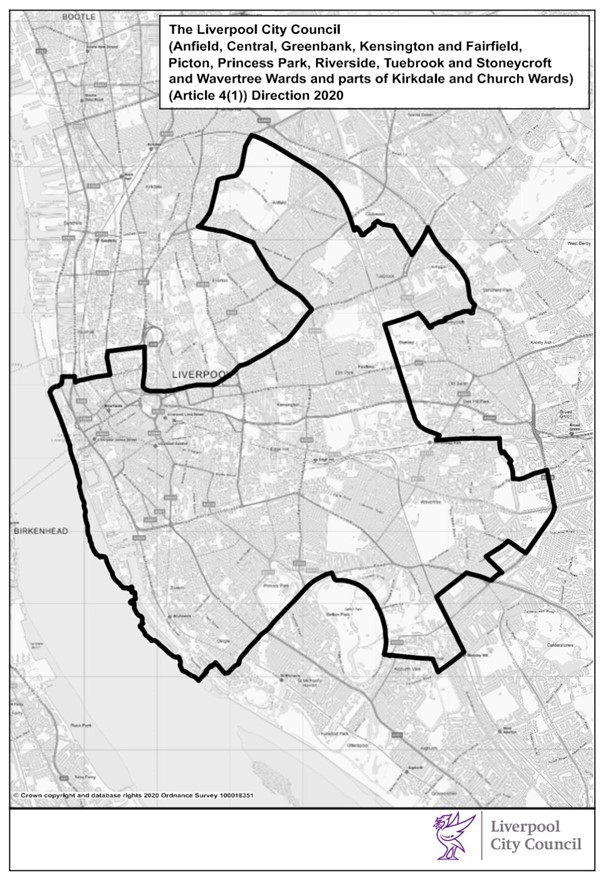
Since 17 June 2021, Liverpool City Council has applied Article 4 restrictions to specific parts of the city to control the concentration of HMOs. If you’re investing or developing in these areas, you must apply for planning permission for any new HMO conversion – even for 3–6 occupants.
Affected Wards (Full Coverage):
Partially Affected Areas:
Make sure to consult the official Liverpool Article 4 map before proceeding with any HMO plans.
Landlords who wish to convert properties into HMOs must submit a planning application to the local authority. The council will then consider the impact this will have on the local area before authorising.
It is, therefore, an important consideration for anyone investing in property in an Article 4 area, as there is no guarantee planning permission will be approved. However, it could be beneficial in some ways, and the property may go up in value, as there is a higher demand for properties in Article 4 areas.
Understanding where Article 4 applies is crucial for any landlord or investor. The rules vary by location, and getting it wrong could mean wasting time and money on failed applications or enforcement issues.
Need help navigating Liverpool’s planning process or sourcing compliant properties? Speak to local experts or property consultants who know the HMO market inside out.
Get in touch with our team today on 0151 380 0200 or info@emperorhome.co.uk.